

Machine Train Alignment: A Step-by-Step Guide to Achieving Precision and Preventing Downtime

Machine train alignment is one of the most critical precision maintenance procedures for rotating equipment. Whether you’re aligning a motor, gearbox, compressor, pump, or turbine, proper shaft alignment across multiple couplings directly affects machine reliability, bearing life, energy efficiency, and overall plant performance.
Yet, many technicians approach machine train alignment as if it were a standard two-machine shaft alignment. In reality, a machine train presents unique challenges that require a different methodology, careful planning, and a clear understanding of movement constraints.
When executed correctly, machine train alignment minimizes vibration, prevents premature failures, avoids bolt-bound conditions, and extends the service life of couplings, seals, and bearings.
What Is Machine Train Alignment?
A machine train consists of three or more machines connected by two or more couplings. Examples include:
Unlike conventional shaft alignment involving one coupling, machine train alignment requires coordinating movement across multiple machines while maintaining two stationary reference points. Every machine in the train may be movable, making alignment strategy significantly more complex.
Without proper planning, excessive moves can create bolt-bound conditions, piping stress, and extended downtime.
Why Proper Machine Train Alignment Matters
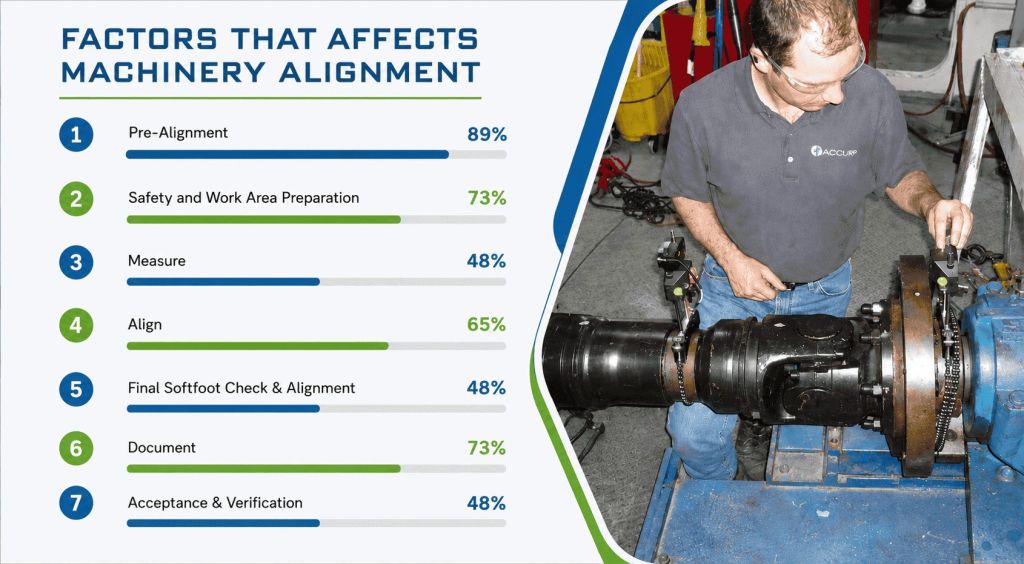
Misalignment in rotating equipment can lead to:
- Excessive vibration
- Increased power consumption
- Premature bearing failure
- Coupling wear
- Seal leakage
- Higher operating temperatures
- Unplanned shutdowns
- Reduced machine reliability
A properly aligned machine train delivers:
✔ Longer bearing and seal life
✔ Lower maintenance costs
✔ Reduced energy losses
✔ Increased equipment availability
✔ Improved vibration levels
✔ Greater overall equipment reliability
How Do You Align a Machine Train?
Step 1: Create a Machine Train Model
Before taking measurements, create a dimensional model of the entire machine train.
Include:
- All machine feet locations
- Coupling positions
- Distances between components
- Fixed and movable points
Modern laser shaft alignment systems simplify this process by allowing technicians to digitally model the machine train and simulate movement scenarios before making corrections.
Proper modeling becomes essential when optimizing machine movements and minimizing shim changes.
Step 2: Measure Every Coupling Before Moving Anything
One of the biggest mistakes in multi-coupling alignment is moving machines too early.
Instead:
- Measure every coupling.
- Record the as-found alignment condition.
- Verify repeatability by taking multiple readings.
- Confirm measurement consistency before proceeding.
Since machine train alignment involves several movable elements, a bad reading at one coupling can multiply correction errors throughout the system.
Using a laser alignment system improves accuracy and eliminates guesswork compared to dial indicators.
Step 3: Analyze Current Alignment Conditions
Once measurements are collected, visualize the entire train.
Many laser shaft alignment tools provide graphical representations of:
- Vertical offset
- Horizontal offset
- Angular misalignment
- Relative machine positions
Even when software performs the calculations, understanding the machine geometry remains essential.
Mapping the alignment condition helps technicians determine:
- Which machines should remain stationary
- Which machines can be moved
- How to minimize corrections
- How to avoid piping-induced stresses
Step 4: Determine the Best Alignment Scenario
Unlike single-coupling shaft alignment, machine train alignment does not require one stationary machine.
Instead, it requires two stationary points.
Different stationary points may be selected for:
Vertical Alignment
A heavily piped machine or a machine with no shims beneath its feet may be better left stationary.
Horizontal Alignment
Machines with limited bolt-hole clearance or bolt-bound conditions may become horizontal reference points.
In many cases, keeping both end machines fixed and moving the interior machines results in the smallest overall corrections.
Evaluating multiple movement scenarios before touching the machines often saves hours of rework.
Step 5: Correct Vertical Alignment First
Vertical corrections always come before horizontal corrections because shim changes can influence horizontal positioning.
The process should follow this sequence:
- Add or remove shims.
- Correct all movable machines simultaneously.
- Remeasure every coupling.
- Confirm the effectiveness of the move.
- Continue until alignment tolerances are achieved.
Accurate vertical alignment reduces vibration and prevents unnecessary stress on bearings and seals.
Step 6: Complete Horizontal Alignment
After vertical alignment is within tolerance:
- Perform horizontal corrections.
- Move all required machines.
- Measure every coupling again.
- Verify results.
- Repeat until all couplings meet specified tolerances.
Proper horizontal alignment ensures smooth power transmission and helps eliminate unnecessary loading on rotating components.
The Importance of Soft Foot Correction
Soft foot is one of the most overlooked causes of internal machine misalignment.
When a machine foot does not sit flat on its base, tightening anchor bolts distorts the machine frame and creates internal stresses between bearings.
Soft foot problems can lead to:
- Elevated vibration levels
- Bearing failures
- Seal damage
- Alignment instability
The final soft foot condition should typically be reduced to less than 0.002 inches.
Correcting soft foot before final alignment ensures that the machine maintains alignment during operation.
Rough Alignment vs. Final Alignment
Rough alignment positions the machine close enough to allow efficient final corrections.
Its purpose is to:
- Eliminate excessive offset
- Reduce movement requirements
- Prepare for soft foot correction
- Display remaining misalignment at the coupling
If rough alignment is done properly, final alignment often requires only:
- One vertical move
- One horizontal move
This significantly reduces downtime and improves maintenance efficiency.
Final Alignment Verification and DocumentatioN
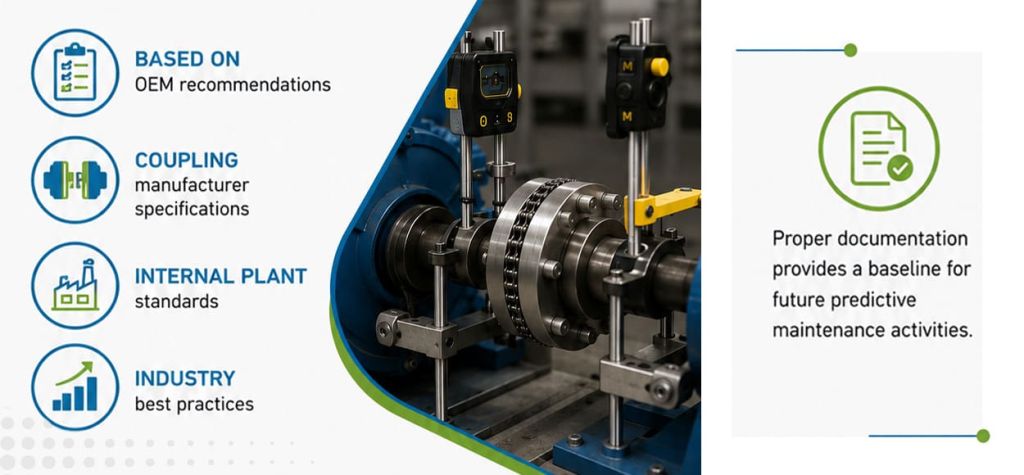
Final shaft alignment tolerances should be based on:
- OEM recommendations
- Coupling manufacturer specifications
- Internal plant standards
- Industry best practices
After tightening all anchor bolts, perform one final measurement and verify:
- As-left alignment conditions
- Soft foot values
- Coupling alignment results
Proper documentation provides a baseline for future predictive maintenance activities.
Document Every Machine Train Alignment
Alignment reports should include:
- As-found readings
- As-left readings
- Soft foot measurements
- Machine dimensions
- Alignment tolerances
- Correction values
Historical alignment records help maintenance teams identify recurring problems and optimize preventive maintenance schedules.
Benefits of Precision Machine Train Alignment
When performed correctly, machine train alignment provides measurable benefits:
- Reduced vibration and dynamic forces
- Longer bearing and seal life
- Improved gearbox reliability
- Lower energy consumption
- Fewer unexpected failures
- Reduced downtime
- Higher overall equipment effectiveness (OEE)
- Increased asset reliability
By implementing a systematic machine train alignment procedure, maintenance teams can achieve faster alignments, avoid bolt-bound conditions, and maximize the performance of critical rotating equipment.
Precision alignment isn’t simply about meeting tolerances (it’s about improving machine reliability and protecting the assets that keep your operation running).
About the Author
Damian Josefsberg is an Applications Engineer at ACQUIP specializing in precision maintenance and alignment technologies. He performs field services and technical training involving laser shaft alignment, machine train alignment, bore alignment, diaphragm alignment, and thermal growth studies.
Damian has supported industries including power generation, oil and gas, pulp and paper, food processing, automotive manufacturing, marine, and pipeline operations. He holds a Mechanical Engineering degree from Florida Tech and is certified in vibration analysis and multiple laser alignment systems.
View More